History of the Parish
History of the Parish
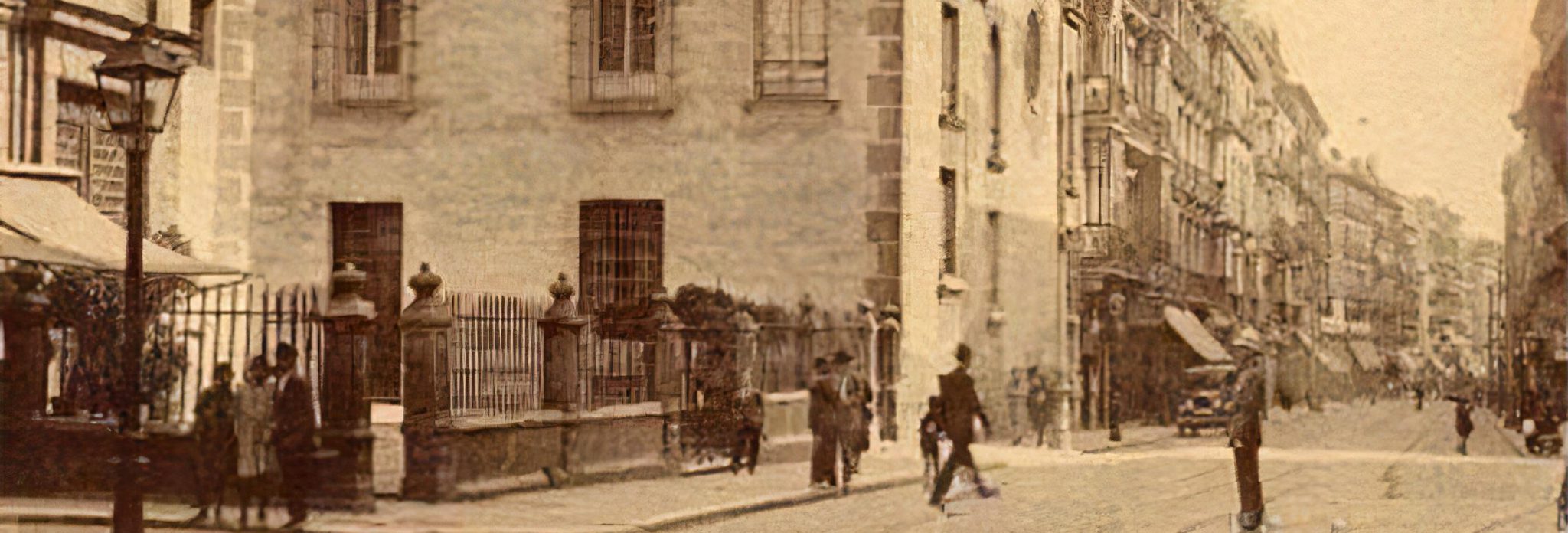
Two faces, like some people, has the parish of San Sebastián… or rather, the church… two faces that are surely more amusing than beautiful: one looks toward the lower neighborhoods, facing them down Cañizares Street; the other toward the mercantile nobility of Plaza del Ángel.
Two faces, like some people, has the parish of San Sebastián… or rather, the church… two faces that are surely more amusing than beautiful: one looks toward the lower neighborhoods,
facing them down Cañizares Street; the other toward the mercantile nobility of Plaza del Ángel.
— Benito Pérez Galdós
Thus begins Misericordia, a novel by Benito Pérez Galdós, one of the most important Spanish writers of the 19th century. A faithful depiction of the lives of Madrid's most humble classes, the novel places this text at the rear of the parish of San Sebastián. In it, the author accurately attributes two defining traits to this church: grandeur and wretchedness. Both have accompanied the parish of San Sebastián throughout its history and have made it one of Madrid’s most significant historical landmarks.
The period of greatest splendor for the Church of San Sebastián spans from its founding in the 16th century until its near-total destruction in 1936 during the Spanish Civil War. Nearly four centuries of magnificence were brought to an abrupt end by the senseless violence of a war that ravaged Spain for three years. Nevertheless, this iconic parish has managed to rise from the ashes and, following its reconstruction, it houses numerous artistic treasures worth visiting.
Declared a Site of Cultural Interest (Bien de Interés Cultural) in the category of historic-artistic monument on October 16, 1969, the church also preserves a significant archive containing records of baptisms, births, marriages, and deaths of many of Spain’s most illustrious cultural and artistic figures. Among them are Miguel de Cervantes, Leandro Fernández de Moratín, Luis Madrazo, Jacinto Benavente, Lope de Vega, Ventura Rodríguez, Juan de Villanueva, José de Espronceda, Gustavo Adolfo Bécquer, and Mariano José de Larra.
First Construction
On May 1, 1541, then Archbishop of Toledo, Cardinal Juan de Tavera, ordered the construction of a small hermitage under the dedication of Saint Sebastian.
Second Construction
This led, in 1554, to the building of a larger temple commissioned to master builder Antonio Sillero. However, due to a lack of financial resources, progress was slow, and by 1576 the vault of the central nave was still not completed. Although worship began in 1578, construction continued with the building of the main chapel, sacristy, cemetery, and interior decoration.
Regarding the exterior, the façade was designed by Sillero, while the bell tower was the project of master builder Lucas Hernández. Construction of the tower began in the early 17th century, though no part of it remains today. It is believed to have resembled that of the Church of San Ginés.
After the temple's completion, several congregations and brotherhoods were established, such as the Brotherhood of Mercy (one of the oldest in Madrid), the Brotherhood of Christ of Faith and the Palace Halberdiers, the Brotherhood of Our Lady of the Ninth of Spanish Performers, and the Brotherhood of Our Lady of Bethlehem of the Architects.
Over the centuries, the Church of San Sebastián accumulated works of art and numerous ornaments for its chapels, mostly sponsored by these brotherhoods or donated by private patrons.
Civil War and Destruction
The splendor of the Church of San Sebastián was completely ruined during the Spanish Civil War. In the early months of the conflict, radical members of the Republican side launched a campaign of burning and looting Catholic churches. Due to its central location, San Sebastián was assaulted and nearly entirely burned down, with only the historical archive remaining intact. This archive still preserves numerous documents about the construction of the parish, as well as its close ties to Spanish Golden Age literature through baptism, marriage, and death records.
Furthermore, in late August 1936, Madrid began to be bombarded by the Nationalist side. On November 18, during an attack on Plaza de Antón Martín led by the Condor Legion, several bombs struck the Church of San Sebastián. It was suspected that the church housed a Republican military supply depot. After the bombing, only parts of the apse, the Architects’ Chapel, the façade, and the bell tower remained standing.
Later, the tower was demolished by order of the City Council, which wanted to widen San Sebastián Street. Although the plan was to rebuild it slightly further in, it was never carried out.
Reconstruction of San Sebastián

After the war, the reconstruction of the temple began under the direction of architect Francisco Íñiguez Almech. Works started in 1943 with several major changes. Although the initial plan aimed to reconstruct the original church entirely, it was necessary to completely change its orientation. This was due to the irregular terrain and the obligation to preserve the remains of the former main chapel and the Architects’ Chapel, as well as the tower and parts of the Actors’ Chapel, which were affected by the widening of San Sebastián Street by the City Council. Rebuilding according to the original layout was therefore ruled out.
The new orientation repositioned the main altar to a side wall. The new main chapel was built next to the old cemetery, which was removed during the renovation and replaced by a flower shop. Interestingly, according to the parish archives, Lope de Vega was buried in that cemetery. However, when his heirs ceased to pay for the crypt rights, the illustrious playwright was buried in a communal ossuary, making his remains unidentifiable today.
After Íñiguez Almech’s intervention, the church was left with two clearly distinct sections: the older area, comprising the current chapels of Bethlehem, the Sacred Heart of Jesus, and Our Lady of Mercy, and the more modern section, which follows an octagonal layout and is topped with a large central dome with lanterns and a choir at the rear. The church of San Sebastián was reopened to the public in 1959.
BIC Declaration / Historical Archive
Finally, it is worth noting that the Church of San Sebastián was declared a Site of Cultural Interest in the category of historic-artistic monument on October 16, 1969, in part due to its magnificent archive. This archive contains records of baptisms, births, marriages, and deaths of many of the most distinguished figures in Spanish culture and art. Among them are Miguel de Cervantes, Leandro Fernández de Moratín, Luis Madrazo, Jacinto Benavente, Lope de Vega, Ventura Rodríguez, Juan de Villanueva, José de Espronceda, Gustavo Adolfo Bécquer, and Mariano José de Larra.
Tags:
More History
Illustrious People
This parish, founded in 1541 with the construction of the first chapel, has welcomed countless faithful, among whom are individuals of great historical significance. Some of the most notable are mentioned in an inscription in the temple's atrium.
Read moreStart of Children’s Catechesis
The parish of San Sebastián invites all families to register their children for catechesis, held every Friday at 6:30 PM.
Read moreArchitecture of the Parish
Although the church of San Sebastián no longer preserves its original architecture nor many of the artistic treasures it once housed, it retains others that are well worth a visit.
Read more